Thursday, February 21, 2013

Prototyping

On February 21, the students worked on their prototypes in the apparel lab. The group creating the men's brace discussed alternative closure methods to the zipper. The group creating the women's product explored alternative necklines that are more feminine (such as a sweetheart). Students also considered their potential fit models in creating their products.

The class also prepared for the presentation of their prototypes to faculty and industry next Thursday. The presentations will include an overview of the search for materials, fabric choices, stich types, testing methods, product goals, and how the students assessed fit and needs. They will also discuss how they plan to  move forward with the product development project after spring break.


The school also just received a new machine that does lapped seams from the 600 stitch class, which the students will be able to utilize in creating their products.

Also, the school received materials donations from Hornewood Inc., Asheboro Elastic, and Cotton Inc., which the students greatly appreciate and will be utilizing in their products.


Testing Round Two

On February 20, the students met with Dr. Michielson to conduct round two of testing (sans machine error this time). Several cotton and polyester / spandex blends were tested.


Reading the graphs produced by the histeresis mahcine helped the students to clearly identify which fabrics to incorporate into their products, based on the elastic recovery. Again, certain parts of the product necessitate specific types of stretch, which the class has identified and will accomodate. In the next session, the students will discuss their fabric choices and make final decisions as they prepare to ebgin the construction of their prototypes.

Friday, February 15, 2013

Making Progress

On February 14 (Valentine's Day, to the dismay of the students!), the class discussed the project moving forward. It was determined that each team (since there is one team for a women's product and one team for a men's product) will create three protoypes--a small, a medium, and a large. Several students have already begun experimenting with their potential fabric choices and construction methods.

The class also talked about the IRB (Institutional Review Board) paperwork, which consists of the submission form and an informed consent form for subject participation. Anytime you work with human subjects where the data you collect may be used outside of the classroom, you need to have approval from the IRB office. It was important that the students participated in this step, as it is part of the process and so that they know the limitations for when testing begins. As a group, the students and faculty made changes to most accurately reflect the protoyping and testing processes that will occur later on in the semester. The students will also be conducting a survey of the participants and had submitted potential questions prior to class. The point of this survey is to more fully understand the needs of the intended market and to identify areas for improvement in the product.

Finally, it was determined that each student will recruit one male and one female to test the products after Spring Break, hopefully from a variety of sizes.

Next week, the students will meet to once again test their fabric samples for stretch and recovery so that they may make final fabric selections and begin constructing prototypes as soon as possible.

Testing the Fabrics


On February 7, the students worked with Dr. Michielsen to conduct histeresis tests on their fabric samples. These tests allowed them to test for stretch and recovery, as they do not want permanent distortion to occur in the product.

However, the tests did not yield proper results due to some problems with the machine. The students will test the samples again next week, at which point they will determine the fabrics to be used in their prototypes.

Tuesday, February 12, 2013

About TransDRY


Check out the link below for some cool videos demonstrating the TransDRY technology in action!

http://www.cottoninc.com/product/Product-Technology/Moisture-Management/Transdry/Multimedia/

Meeting With Cotton Incorporated

On February 1, David Earley, Senior Director of Global Supply Chain Marketing at Cotton Incorporated, came to talk to the students about Cotton Inc.'s TransDRY performance fabric. By integrating functional finishes, Cotton Incorporated can build demand for cotton. Several companies, including Under Armour, currently use the TransDRY performance cotton in their products.
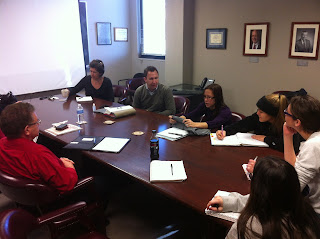
The TransDRY fabrics feature a blend of specially-treated water-repellent cotton and naturally absorbent untreated cotton to create an overall aboserbent capacity that mimics polyester and nylon. These treated and untreated fibers work together to help transfer moisture so that the fabric dries faster and does not become over-saturated during exercise. They also allow fabric to wick and spread perspiration as well as, or better than, most high-tech synthetic fabrics but without sacrificing the comfort and softness of cotton. The students looked at dozens of fabric samples of varying weights and with different properties. They also tested each one with water droplets in order to examine how the fabrics managed moisture.
Some fabrics moved moisture horizontally or vertically while others moved moisture from the skin side to the outside of the fabric.

The students then began to consider the needs of the bra and which fabrics (cotton versus synthetic) would be appropriate for different areas of the product (based on properties and performance).

They left the meeting with the assignment to compile a "wish list" of ideal properties that the fabrics in the product would have and that they would like to test for in the fabric samples. They also prepared to reverse engineer the sample products in order to better understand the construction and to create patterns for prototyping.

Monday, February 11, 2013

Anatomy of a Bra

On January 31, Dr. Istook gave a presentation on the construction of bras and the corresponding terminologies.

The students also learned about taking accurate measurements, fit, cross grading, and common fitting solutions. Many were surprised to learn that all same cup sizes are not equal and that band measurements impact cup size. Backed with this information, the students began to brainstorm how they could improve the posture bra by taking into consideration the various components of the product.
The students ended the session by considering which types of materials to incorporate into the product. They examined numerous fabrics donated by Hornwood that included polyester, nylon, and spandex blends in varying compositions.